The future is not a place.
Raising a child in the era of surveillance capitalism and "cloud capital". A structural question about predictability, behavioral automation, and resistance.
The future is not a place; it's someone I love.
This sentence only makes sense if we refuse the grammar in which the word "future" operates today — as a market horizon, as a technological roadmap, as a trend. The future-as-a-place is a useful abstraction for those who need to sell a destination. But anyone who cares for a child knows the future is something else. It is a small body that will cross decades in which I will not be entirely present to see. It is a concrete question: what is essential for this person to learn, before the world learns for them?
The question seems pedagogical. It's not just that. It's structural.
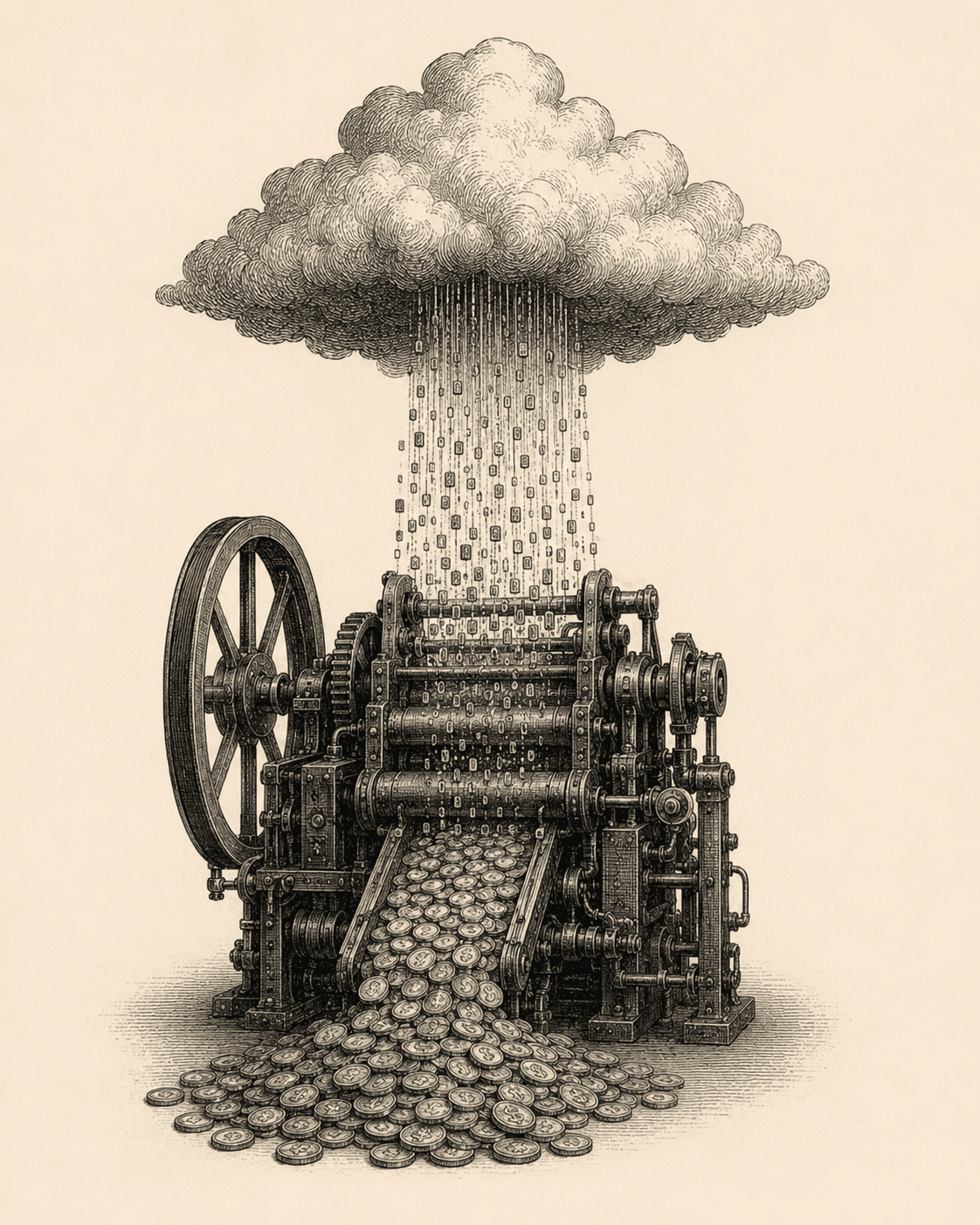
The Greek economist Yanis Varoufakis argues, in Technofeudalism: What Killed Capitalism (2023), that capital has changed its nature. We are no longer in a system where value comes from market profit; we are in a system where value comes from rent extracted from a platform — what he calls cloud capital. The thesis is contested. Sociologists like Nicholas Gane and theorists like Jodi Dean disagree with the term "technofeudalism" and prefer to talk about a mutation of capitalism, not its death. But there is convergence on the baseline diagnosis: the dominant economic model today is not one of exchange, but of capture.
This detail matters to anyone raising a child. Because capture, as Shoshana Zuboff showed in The Age of Surveillance Capitalism (2019), is not an accident of the system — it is the system itself. The raw material of these platforms is human behavior transformed into data, and the goal is what Zuboff clinically names: behavioral modification. Tuning, herding, conditioning.
The phrase from Zuboff that haunts me is this: the goal of the platforms is no longer to know human behavior. It is to automate humans.
This is the point where the question about education ceases to be pedagogical and turns political. Because if the dominant business model of the decade needs the subject to be predictable — and needs this early on, the sooner the better, because children's data is more malleable —, then teaching a child to be unpredictable, to have a mind of their own, to resist the automation of their own behavior, is not a future skill. It is counter-conduct.
Zuboff calls what is at stake the right to the future tense. The right to future time. The ability to project myself into tomorrow and to make that tomorrow a present dimension of what I choose. Without this right, she writes, there is no autonomy — and without autonomy, neither moral judgment nor critical thinking is possible.
What is being negotiated when an algorithm decides the next video a seven-year-old child will watch is not entertainment. It is their future tense. It is the ability to want something that the system has not predicted.
This is the dark side. There is the other side, which is the question about work — that everyone gets wrong.
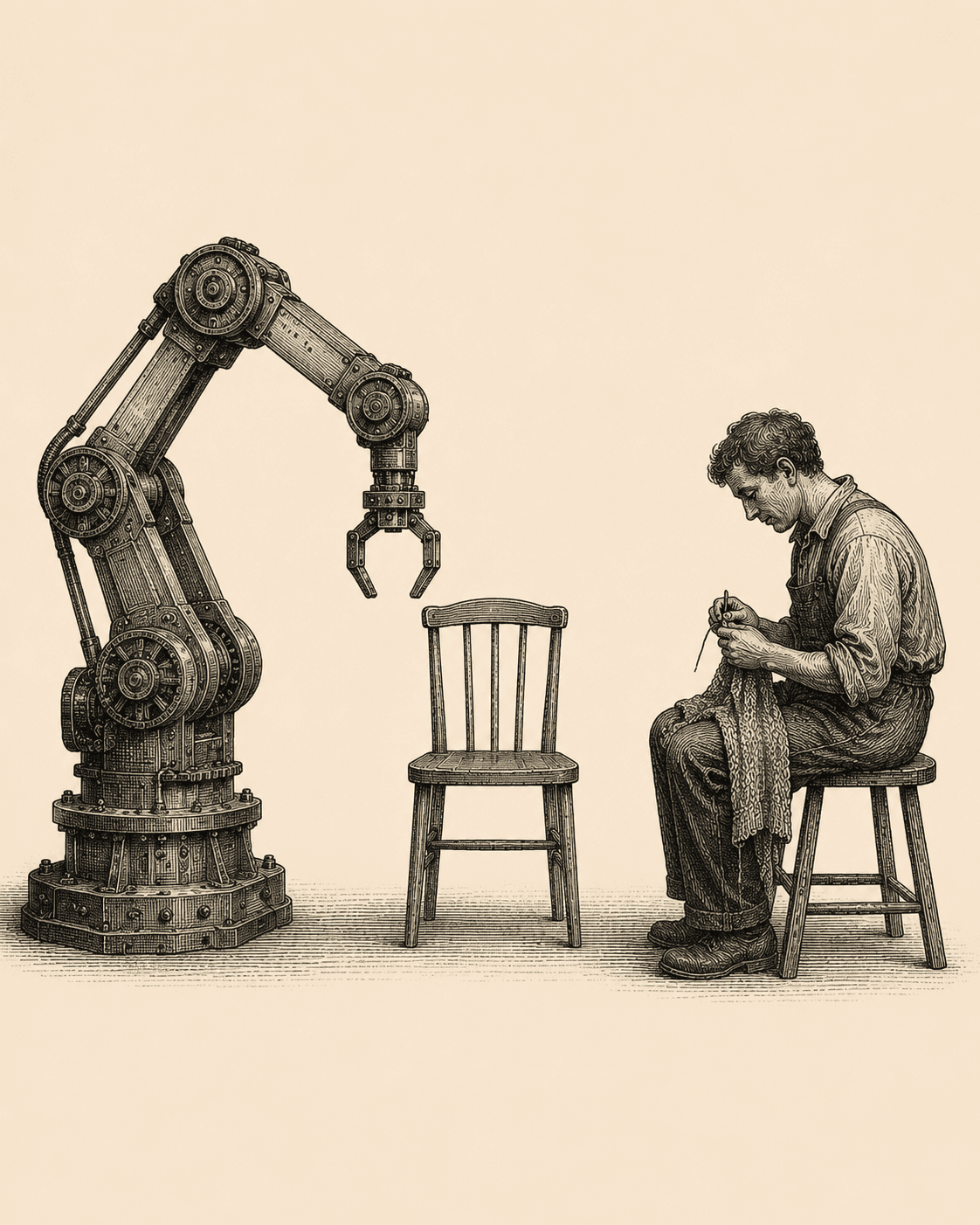
The wrong question is "what will machines occupy?". Factories have been automating for decades. Banks replaced tellers with ATMs in the 80s. Automation is not new. What changes is the scope. But the question about machine occupation is always formulated from the machine's perspective, as if it had its own historical agency and we were the residue.
The anthropologist David Graeber inverted this question before he died. In an interview with Dissent Magazine in 2018, around the release of Bullshit Jobs, he dropped a sentence that should be the starting point of every serious discussion about work and AI:
“We never wanted a robot to calm drunks or comfort lost children. We need to see value in the kind of work that we only want humans to do.
The question is not what the machine can do. It's what we don't want it to take over.
Care is the obvious example. Not because the machine can't simulate care — it can, increasingly well, and the fact that it can simulate it is not an argument against it. The argument is that care is the activity where human presence is the thing itself, not a medium. A robot can execute the gesture of holding a crying child. But the gesture is not the care; the gesture is the signified of care. What heals is the other consciousness on the other side of the gesture — and this, by definition, a machine lacks.
bell hooks, in All About Love (2000), writes that care and support are the foundation of love, in opposition to abuse and humiliation. The sentence is seemingly simple. It's not. She is saying that love is not a feeling — it is a practice. And that this practice is learned, or unlearned, in childhood, in the first environment where the child exists.
In Teaching to Transgress (1994), hooks goes further: educating is an act of love, and love is a political act. Teaching a child is, always, taking a stand on what kind of subject one wishes to see existing in the world. Pedagogical neutrality is fiction. All education makes choices, even when it pretends not to.
Putting all four layers together — Varoufakis on capital, Zuboff on capture, Graeber on work, hooks on love — the original question reorganizes itself. It's not "what skills should we teach a child for the future?". It is: in a world whose dominant economic model needs to capture their attention, modify their behavior, automate their predictability, and outsource their judgment, what is essential that they learn so they can remain someone?
Three things, I would say. Prior to any technical skill, prior to any skill listable on a resume.
- I. Sovereign Attention.The ability to sit with something without being pulled away from it. This is exactly the opposite of what the business model needs. A child who can stay with one thing — a book, a problem, a silence, another face — is a child the system cannot monetize at the pace it requires. Attention is sovereignty. It's not app-based mindfulness; it's the muscular discipline of choosing where consciousness leans.
- II. Care.Giving and receiving. Recognizing the other consciousness on the other side of the gesture. It is the ability that no machine occupies because of the nature of the activity, not because of technical limits. It is also the skill systematically taught to girls and denied to boys, and this gender cut is part of the structural problem, not an accident. If care is the human work that remains, and if care continues to be invisible women's work, automation will redistribute the rent of everything else — while what matters remains valueless in GDP.
- III. Own Judgment.Thinking for oneself. The system needs them to outsource this. The algorithm wants to decide for them what to watch, what to want, who to talk to, what to believe. A child who learns to doubt their own feed, to ask who profits from the next suggestion, to suspend judgment until they understand where the information comes from — this child is technically ungovernable by the model. This is what Zuboff would call the exercise of the right to the future tense.
None of this appears as a subject in any national curriculum. There is no "sovereign attention". There is no calculation of care in exams. Independent judgment, when it appears, comes disguised as "critical thinking" — an expression so hollowed out by educational consulting that it has become synonymous with "knowing how to express an opinion in class."
These three things are learned elsewhere: in relations. With an adult who pays attention back, who cares without performativity, who thinks out loud and lets the child follow the reasoning as it forms. The curriculum of this learning is a shared life. And that is why it is threatened: because a shared life is exactly what the business model needs to replace with engagement.
Raising a child in 2026 is, willing or not, an act of dispute against infrastructures designed to do this work for me — and do it worse, and do it serving the interests of others.
The future is not a place.
A place is an abstraction. A place is where the algorithm promises to take you, where a startup claims to be, where the trend points. A place is what economists plot on projection graphs, what futurists sell in keynotes, what platforms swear they have discovered about what comes next.
The future is someone. Someone specific, with a name, a body, a particular way of laughing when they get a joke for the first time. Someone I love, who will exist in the world after I'm no longer around to protect them.
This person doesn't need me to prepare them for the future. They need me to teach them to remain themselves — as they traverse a system built to make them more predictable, more distracted, more modifiable, and more profitable.
This, I suspect, is all education ever was. It's just that the system used to be slower and less intelligent. Now it's learning alongside us.
References and Notes
- Varoufakis, Yanis. Technofeudalism: What Killed Capitalism. Melville House, 2023.
- Zuboff, Shoshana. The Age of Surveillance Capitalism: The Fight for a Human Future at the New Frontier of Power. PublicAffairs, 2019.
- Graeber, David. Bullshit Jobs: A Theory. Simon & Schuster, 2018. Additional interview in Dissent Magazine, August 2018.
- hooks, bell. Tudo sobre o amor: novas perspectivas. São Paulo: Elefante, 2020 (original: All About Love, 2000).
- hooks, bell. Ensinando a transgredir: a educação como prática da liberdade. São Paulo: WMF Martins Fontes, 2017 (original: Teaching to Transgress, 1994).
- *Regarding the scientific controversy over Haidt's thesis in The Anxious Generation (which I chose not to use as an anchor in this essay): see Odgers, C. L., review in Nature (2024); Fassi et al., Nature Human Behaviour (2025); Orben & Przybylski, Nature Human Behaviour (2019).